martes, 25 de septiembre de 2018

ppprogressive

Image result for present perfect continuous

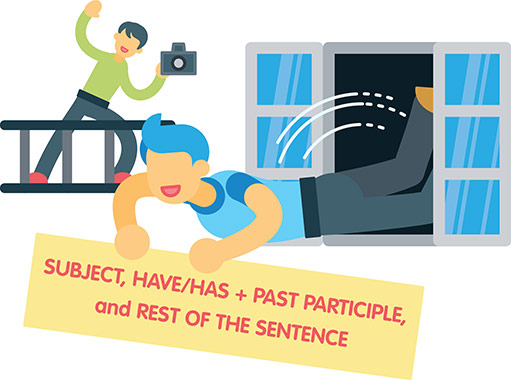
The present perfect continuous (progressive) expresses an action that has recently stopped or is still going on. It emphasizes the duration of the action.


Read the grammar explanation and do the exercise.
The present perfect simple suggests completion while the continuous suggests something is unfinished.

Present Perfect Simple and Present Perfect Continuous

We use the present perfect tense to talk about things where there is a connection between the past and the present.
  • He’s written 16 books.
He started writing books at some time in the past. So far, he has written 16 books. He may write more books.

As well as the present perfect simple, we can use the present perfect continuous tense to talk about events with a connection to the present.

1 Look at these 2 sentences:
  • I’ve been decorating the house this summer. The focus is on the action – decorating – and the action is unfinished.
  • I’ve painted the living room blue. The focus is on the finished result. The activity is finished but we can see the result now.
We use the present perfect continuous when the focus is on an activity that is unfinished.

2 Look at these two sentences.
  • I’ve read that book you lent me. I finished it yesterday.
  • I’ve been reading that book you lent me. I’ve got another 50 pages to read.
The present perfect simple (I’ve read) gives the idea of completion while the present perfect continuous (I’ve been reading) suggests that something is unfinished.

3 Look at these two sentences.
  • She’s been writing emails for 3 hours.
  • She’s written 10 messages.
The present perfect continuous (has been writing) talks about how long something has been happening. The present perfect simple (has written) talks about how much/how many have been completed.

4 Look at these two sentences.
  • I’ve worked here for thirty years.
  • I usually work in London but I’ve been working in Birmingham for the last 3 weeks.
We can use the present perfect simple to talk about how long when we view something as permanent. But the present perfect continuous is often used to show that something is temporary.
1.Put the verbs in brackets into Present Perfect Continuous

1. Geena   (wait) for Tom for two hours.
2. I  (do)my homework since 10 o'clock this morning.
3. The children  (play) computer gamews for half an hour.
4. My sister  (watch) cartoons since this morning.
5. Tom and Annie  (ride) their bikes in the park for three hours.
 
 
2. Fill in with for or since:
a. The dog has been running in the garden  twenty minutes.
b. The man has been working on the project  eight o'clock.
c. Mike's mother has been driving  she left home this morning.
d. Sue and Sally have been making pancakes  an hour.
C. Look at the pictures and write sentences using the Present Perfect Continuous.
 
 (do / aerobics / three hours) 
 (bake / bread / three o'clock) 
 (chat / noon) 
 (play / marbles / went outside) 
 (garden / the whole afternoon) 

martes, 18 de septiembre de 2018

ppp


Image result for present perfect

Write sentences in present perfect simple.

  1. we / reach / our goal - 
  2. our team / lose / the match - 
  3. she / underline / the word - 
  4. they / not / discover / the treasure - 
  5. Ron / not / talk / about the problem - 

Write questions in present perfect simple.

  1. you / knock / at the door - 
  2. the teacher / mark / the tests - 
  3. she / buy / a new computer - 
  4. they / rescue / the girl - 
  5. Brad / wear / a blue shirt - 
  6. I . (+/already/to listen to music)

PUT THE WORD IN ORDER


1. their yet. not They have finished meal 

2. already been Tower. We the have to Eiffel 

3. plane landed Has yet the ? 

4. ? report the you haven't yet done Why 

5. Susan been has already times. three married 

6. seen movie. have that I already 

7. book Have that yet you ? finished 

8. not my done I have homework yet. 

9. my have finished homework yet. not I 

10. to cinema. have gone the already I 

ppp

Image result for present perfect


Write sentences in present perfect simple.

  1. we / reach / our goal - 
  2. our team / lose / the match - 
  3. she / underline / the word - 
  4. they / not / discover / the treasure - 
  5. Ron / not / talk / about the problem - 

Write questions in present perfect simple.

  1. you / knock / at the door - 
  2. the teacher / mark / the tests - 
  3. she / buy / a new computer - 
  4. they / rescue / the girl - 
  5. Brad / wear / a blue shirt - 
  6. I . (+/already/to listen to music)

PUT THE WORD IN ORDER

1. their yet. not They have finished meal 

2. already been Tower. We the have to Eiffel 

3. plane landed Has yet the ? 

4. ? report the you haven't yet done Why 

5. Susan been has already times. three married 

6. seen movie. have that I already 

7. book Have that yet you ? finished 

8. not my done I have homework yet. 

9. my have finished homework yet. not I 

10. to cinema. have gone the already I 


lunes, 10 de septiembre de 2018

pperfect

  1. complete the next sentences with EVER and NEVER
    And translate them on your notebook.


    1. Have you  eaten lobster ?

    2. I have  been to France.

    3. I think I have  really known you.

    4. That’s the smallest car I have driven.

    5. If you  have questions, please don't hesitate to contact me personally.

    6. She is probably the most fascinating woman I have  met.

    7. If you have felt or known real love, you know it is well worth the wait.

    8. Have your children  had Turkish Delight or chocolate-covered pistachios ?

    9. You have no right to say what the greatest movie is if you have  seen “Citizen Kane.”

    10.  have I suggested that a test should replace a teacher ! 
  2. exercise 2
  3. The students  a flight to Vienna. (to book)
  4. The cat  a mouse. (just/to catch)
  5. Jack and Brian  this picture. (just/to draw)
  6. He  his friends. (already/to invite)
  7. Julia  a table with three columns. (just/to make)
  8. My friends  the geography test. (to pass)
  9.  the rabbits. (just/to feed)
  10. The baby hedgehogs  the water. You need to get more. (already/to drink)
  11. The teacher  the keys, so he can't open the door. (to lose)
  12. We  the worksheets. (already/to download)


exercise 2

hange the verb into the correct form:
1. I  (read) your book several times.
2. She  (wear) that skirt many times.
3. My family  (visit) Brazil a few times.
4. I  (eat) already.
5. Marta  (finish) her homework.
6. You  (break) the glass again.
7. They  (pay) for everything.
8. It  (never snow) like that.
9. I  (meet) Anna once.
10. We  (see) him before.
11. You  (buy) 4 cars so far.
12. There  (be) problems.
13. I  (have) a snake.
14. Maria  (raise) a monkey.
15. The kids  (grow) so much!


martes, 4 de septiembre de 2018

past

PAST SIMPLE VS PAST CONTINOUOS

PAST SIMPLE VS PAST CONTINOUOS 

INSTRUCTIONS:   Copy this information on your notebook, and then hand in to your teacher in the next class  to be stamped.

"Past simple" vs "Past continuous"


1. Past simple
El "past simple" describe una acción pasada ya finalizada.
  • When I was young I lived in Madrid (ahora vivo en Barcelona)

2. Past continuous
Indica que una acción se estaba desarrollando en cierto momento delpasado al cual se hace referencia. No dice si la acción ya finalizó o todavía continuaba.
  • When the mother came home her husband was playing with the kids (no sabemos si terminó de jugar en ese momento o continuó jugando)
A veces se describen dos acciones simultáneas que tuvieron lugar en el pasado. En dicho caso, se utiliza el "past imple" para describir aquella que finalizó y el "past continuous" para aquella otra que estaba ocurriendo cuando la primera tuvo lugar.
  • Yesterday evening when you called me I was having a shower
  • When the parents arrived home the children were watching TV
Otra diferencia entre ambos tiempos es que el "past continuous" se utiliza a veces para indicar que la acción es más casual, menos planificada.
  • Yesterday morning, from 8 to 10, I was running (algo rutinario, que suelo hacer con frecuencia, por lo que no lo resalto)
  • Yesterday morning, from 8 to 10, I ran (algo diferente, un tanto extraordinario, por lo que quiero destacarlo)


Simple PastPast Progressive
irregular verbs: see 2nd column of irregular verbs
I spoke
regular verbs: verb + ed
I worked
past form of 'be' + ing form of verb
I was speaking
you were speaking
he / she / it was speaking
we were speaking
they were speaking

Simple PastPast Progressive
irregular verbs: see 2nd column of irregular verbs
I spoke
regular verbs: verb + ed
I worked
past form of 'be' + ing form of verb
I was speaking
you were speaking
he / she / it was speaking
we were speaking
they were speaking

Use

After another or at the same time?

Do you want to express that the actions in the past happened one after another or at the same time?
Simple PastPast Progressive
after another
She came home, switched on the computer and checked her e-mails.
at the same time
Simon was playing on the computer while his brother was watching TV.

New action or already in progress?

If you want to express that a new action happened in the middle of another action, you need both tenses: Simple Past the new action and Past Progressive for the action already in progress.
Simple PastPast Progressive
new action
My mobile rang (when I was sitting in a meeting.)
action already in progress
While I was sitting in a meeting, (my mobile suddenly rang.)

Only mentioning or emphasising progress?

Do you just want to mention that an action took place in the past (also used for short actions)? Or do you want to put emphasis on the progress, e.g. that an action was taking place at a certain time?
Simple PastPast Progressive
just mentioning
Colin played football yesterday.
emphasising progress
Yesterday at six o'clock, Colin was playing football.


Past Continuous and Past Simple

1.  The most common use of the past continuous tense is to talk about something that was happening around a particular time in the past.
  • What were you doing at 8 o’clock last night? I was watching television.
I started watching television before 8 o’clock and I continued watching it after 8 o’clock.
  • In 1994 he was working in a small town in Poland.
  • At 6 o’clock on Saturday morning we were travelling to the airport.
2. We often use the past continuous and the past simple tense together. When this happens, the past continuous describes a longer, ‘background’ action or situation and the past simple describes the action or events.
  • When I woke up this morning it was raining and my father was singing in the kitchen.
  • I was walking home, whistling happily, when I saw two masked men run out of the bank.
Often, the ‘action’ described by the past simple tense interrupts the ‘situation’ described by the past continuous tense.
  • I broke my leg when I was skiing.
  • I was playing a computer game when the doorbell rang.
Notice that the past continuous describes ‘situations’ that go on for some time – ‘skiing’ and ‘playing’ but the past simple describes ‘actions’ that happen quickly – ‘broke’ and ‘rang’.

Notice too the important difference between these two sentences.
  • When they arrived, Jeff was cooking dinner. Jeff started cooking before they arrived.
  • When they arrived, Jeff cooked dinner. Jeff started cooking dinner after they arrived.